
If you’ve started earning money outside a regular paycheck, such as freelancing, selling online, consulting, creating content, or running a side hustle – you’ve probably asked this question:
“Do I need to pay quarterly estimated taxes now?”
Short answer: Maybe.
Long answer: It depends on how you’re paid, how much you earn, and whether taxes are already being withheld for you.
Let’s break it down in plain English.
What Are Quarterly Estimated Taxes?
Quarterly estimated taxes are advance payments you make to the IRS throughout the year when taxes aren’t automatically withheld from your income.
They apply when you earn money like:
- Freelance or contract income (1099 work)
- Side hustle or Etsy sales
- Self-employment income
- Rental income
- Investment income (interest, dividends, capital gains)
- Crypto or NFT income
- Certain retirement or pension income without withholding
If no one is taking taxes out for you, the IRS still expects to get paid during the year, not just at filing time.
Who Actually Needs to Pay Estimated Taxes?
You generally need to pay quarterly estimated taxes if both of these are true:
- You expect to owe at least $1,000 in federal taxes for the year, after credits and withholding
- You don’t have enough tax withheld from other income (like a W-2 job)
If you’re self-employed or earn 1099 income as your main income source, estimated taxes usually apply.
If you have a W-2 job and a side hustle, you might still need them, or you might be able to adjust your W-4 instead (more on that later).
When Are Quarterly Estimated Taxes Due?
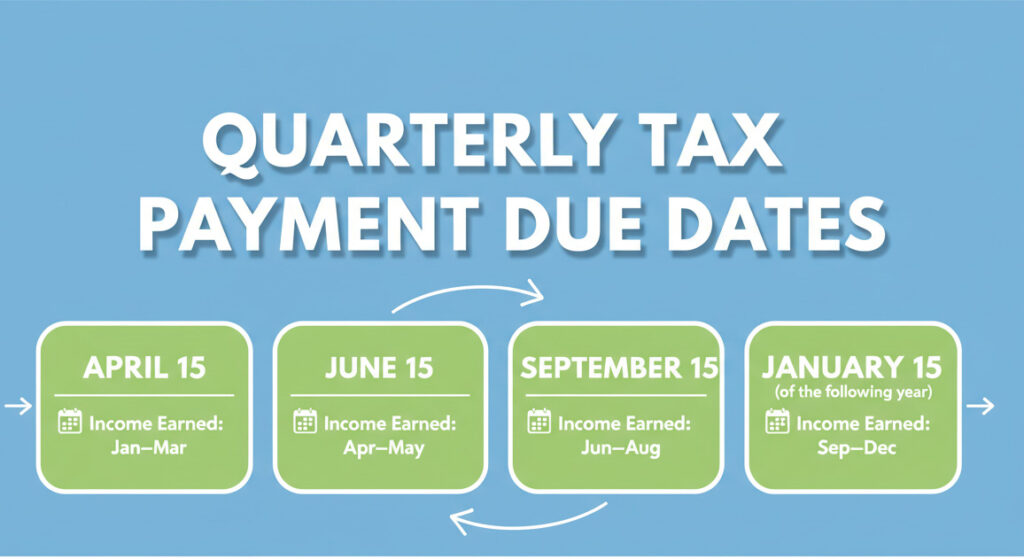
Estimated taxes are paid four times per year, roughly aligned with when income is earned:
- April 15 – for income earned Jan–Mar
- June 15 – for income earned Apr–May
- September 15 – for income earned Jun–Aug
- January 15 (of the following year) – for income earned Sep–Dec
Yes, the schedule is weird.
No, it doesn’t line up perfectly with calendar quarters. Everyone agrees it’s confusing.
How Much Do I Need to Pay Each Quarter?
This is where most people get stuck. There are two main approaches:
Option 1: Pay Based on Last Year (Safe Harbor Rule)
To avoid penalties, you can usually pay:
- 100% of last year’s total tax (or 110% for higher earners)
This is called the safe harbor rule. It protects you from penalties, even if you earn more this year.
Option 2: Pay Based on This Year’s Actual Income
This is more accurate but requires:
- Tracking income as you earn it
- Estimating deductions
- Adjusting payments if income changes
This approach keeps you closer to break-even at filing time, but requires better tracking.
What Happens If I Don’t Pay Estimated Taxes?
If you should have paid and didn’t, the IRS may assess:
- Underpayment penalties
- Interest charges
- A large, painful tax bill at filing time
Penalties aren’t usually massive, but they’re completely avoidable with basic planning.
Can I Avoid Quarterly Payments If I Have a W-2 Job?
Sometimes, yes.
If you also earn a paycheck:
- You may be able to increase your W-2 withholding
- The IRS treats withholding as if it were paid evenly throughout the year
- This can eliminate the need for quarterly payments
This works well for people with:
- A side hustle
- Freelance income on top of a full-time job
But it only works if withholding is accurately adjusted.
The Real Problem: Guessing Instead of Planning
Most people struggle with estimated taxes because:
- Income isn’t predictable
- Deductions are unclear
- Rules feel buried in IRS language
- Calculators don’t reflect real life
So people guess, or ignore it, until April. That’s exactly where things go wrong.
The Bottom Line
If taxes aren’t being withheld from your income, you may need to pay quarterly estimated taxes.
But:
- Not everyone needs them
- There are multiple ways to stay compliant
- You don’t need to be perfect, you just need a system
The earlier you get clarity, the easier the rest of the year becomes.
Disclaimer
This article is for educational purposes only and does not constitute tax, legal, or financial advice. Tax situations vary. Consult a qualified tax professional for advice specific to your situation.
Leave a Reply